
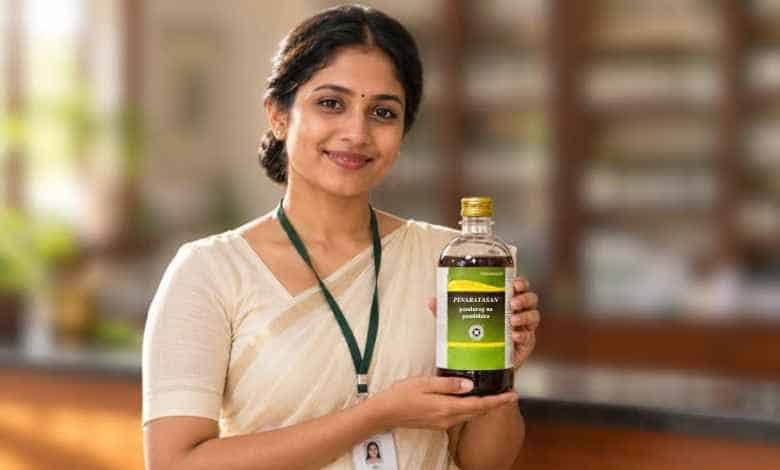
Punarnavasavam is a classical Ayurvedic fermented liquid tonic best known for supporting healthy fluid balance, reducing swelling and supporting liver and digestive health.
Like other fermented Ayurvedic tonics, it develops a small amount of natural alcohol during preparation, which is believed to help the body absorb its herbal ingredients more effectively.
Its main ingredient is Punarnava, combined with digestive spices, Triphala, liver-supportive herbs and Guduchi.
This mixture is sweetened with sugar and honey, fermented naturally with Dhataki flowers and grapes, and finished with a blend of supportive herbs.
Ayurveda emphasises that fermentation draws out the active compounds in these herbs and makes them easier for the body to use, giving Punarnavasavam its supportive action on fluid retention, swelling, digestion and the liver.
Ingredients
Punarnavasavam is prepared by fermenting a decoction of Punarnava and a group of digestive, liver-supportive and anti-inflammatory herbs with sugar, honey, grapes and Dhataki flowers. It is composed of the following ingredients:
- Saccharum officinarum (Sita, sugar)
- Madhu (honey)
- Zingiber officinale (Nagara, dry ginger)
- Piper nigrum (Maricha, black pepper)
- Piper longum (Pippali, long pepper)
- Terminalia chebula (Haritaki)
- Phyllanthus emblica (Amalaki)
- Terminalia bellirica (Vibhitaki)
- Berberis aristata (Darvi/Daruharidra)
- Tribulus terrestris (Swadamshtra/Gokshura)
- Solanum anguivi (Brihati)
- Solanum virginianum (Nidigdika/Kantakari)
- Justicia beddomei (Vasa)
- Ricinus communis (Erandamula, castor root)
- Neopicrorhiza scrophulariiflora (Katuki)
- Scindapsus officinalis (Gajapippali)
- Boerhavia diffusa (Shophaghni/Punarnava)
- Azadirachta indica (Pichumarda, neem)
- Tinospora cordifolia (Guluchi/Guduchi)
- Smilax china (Sushkamulaka)
- Tragia involucrata (Duralabha)
- Trichosanthes cucumerina (Patola)
- Woodfordia fruticosa (Dhataki)
- Vitis vinifera (Draksha, grapes)
- Self-generated alcohol, produced naturally during fermentation
- Purified water
Ayurvedic properties of Punarnavasavam
Punarnavasavam is known for its fluid-balancing, anti-inflammatory and liver-supporting action, with a light, sharp and heating character.
- Taste: Bitter, pungent, astringent, sweet
- Qualities: Light, dry, sharp, subtle, mobile
- Potency: Heating
- Post-digestive effect: Pungent
- Action over doshas: Balances Kapha and Vata, supports healthy urine output, reduces swelling, digests metabolic toxins
- Key actions: Supports healthy fluid balance, reduces inflammation and oedema, supports liver function, improves digestion
- Special note: Even though its taste is chiefly bitter and pungent rather than distinctly diuretic in character, Punarnava gives Punarnavasavam a marked fluid-balancing and anti-swelling effect that goes beyond what its taste alone would suggest.
Because of its heating, mobile nature, it works best for Kapha-Vata conditions involving swelling, fluid retention and sluggish digestion, and is used with care in high-Pitta conditions such as gastritis or marked dehydration.
Use of Punarnavasavam in Ayurvedic Treatment
Punarnavasavam is commonly used for conditions involving fluid retention, swelling, and liver and digestive weakness. It is commonly used in:
- Generalised swelling (oedema) and fluid retention
- Ascites and abdominal fluid build-up, as an adjuvant
- Liver disorders, including early liver dysfunction
- Urinary difficulties and reduced urine output
- Indigestion and poor appetite
- Anaemia, as an adjuvant
- General weakness following illness, when fluid retention is also present
- Mild heart-related swelling, as an adjuvant, under physician supervision
How does Punarnavasavam work
Punarnavasavam works through the combined action of Punarnava and a group of digestive, liver-supportive and anti-inflammatory herbs.
Punarnava, the main ingredient, is traditionally regarded as one of Ayurveda’s foremost herbs for supporting healthy fluid balance and reducing swelling, and it also supports the liver and kidneys.
Guduchi and neem support the body’s natural resistance and add to the anti-inflammatory action.
Triphala (Haritaki, Amalaki, Vibhitaki), along with Daruharidra and Katuki, support digestion and liver function, while Gokshura supports the urinary system.
Ginger, black pepper and long pepper sharpen digestion and improve the absorption of the other herbs.
Fermentation with sugar, honey, grapes and Dhataki flowers produces a small amount of self-generated alcohol, which is believed to act as a carrier that improves absorption of the herbal compounds and supports their overall effect.
Laboratory studies on the individual ingredients report that Punarnava’s alkaloid content has diuretic and anti-inflammatory activity, and other components of the formulation, such as those from Daruharidra, have shown liver-supportive and antimicrobial properties in preclinical research.
These findings are broadly consistent with Punarnavasavam’s traditional use in swelling, fluid retention and liver support, though controlled clinical trials on the complete formulation remain limited.
Conditions Punarnavasavam helps to treat
- Generalised swelling and fluid retention
- Ascites and abdominal fluid build-up (as an adjuvant)
- Liver disorders and early liver dysfunction
- Urinary difficulties and reduced urine output
- Indigestion and poor appetite
- Anaemia (as an adjuvant)
- General weakness with fluid retention
- Mild heart-related swelling (as an adjuvant)
Benefits of Punarnavasavam
- Supports healthy fluid balance and helps reduce swelling
- Supports liver function
- Helps improve appetite and digestion
- Supports healthy urine output
- Has anti-inflammatory and antioxidant properties
- May support recovery from anaemia as an adjuvant
- Helps in general weakness accompanied by fluid retention
- Can be combined with other therapies for a broader supportive effect
Unlike simple diuretic herbs, Punarnavasavam has a broader digestive and liver-supportive action alongside its fluid-balancing effect, making it especially useful when swelling accompanies poor digestion or liver weakness.
Direction for usage
Punarnavasavam is taken orally:
- Adults: 15–30 ml twice daily, mixed with an equal quantity of water, after food, or as directed by a physician.
- Children: Only under medical supervision, at a reduced dose.
- It is usually taken for several weeks to a few months, depending on the condition, and fluid status should be monitored during treatment.
- The dose and duration should be decided by an Ayurvedic physician according to the condition, age and strength of the person.
With other Ayurvedic medicines: Punarnavasavam is commonly combined with other Ayurvedic medicines, depending on the condition:
- In swelling and fluid retention: with Punarnavadi Guggulu or Gokshuradi Guggulu
- In liver disorders: with Kumaryasavam or Arogyavardhini Vati
- In anaemia: with Ayaskriti or Dhatri Loha
- In digestive weakness: with Abhayarishtam
Interaction with other medicines
Anyone taking regular modern medicines should inform their doctor before starting Punarnavasavam, especially in the following cases:
- Diuretics: Punarnava has a diuretic effect of its own, so combining it with prescribed diuretics may increase fluid loss and affect electrolyte levels. This combination should be supervised by a physician.
- Blood pressure medicines: The diuretic action may add to the blood-pressure-lowering effect of these medicines, so blood pressure should be monitored.
- Anti-diabetic medicines and insulin: Some of the herbs and the sugar/honey base may affect blood sugar levels. Blood glucose should be monitored regularly.
- Immunosuppressants and steroids (such as azathioprine, methotrexate, tacrolimus, cyclosporine, prednisolone): Guduchi has an immune-stimulating effect and may work against these medicines, so caution is advised in people on immunosuppressive therapy.
- Medicines that are hard on the liver (such as paracetamol in high or prolonged doses, anti-tuberculosis drugs): Since Punarnavasavam is used in liver-related conditions, people with existing liver disease taking such medicines should be monitored closely.
- Blood thinners and antiplatelet medicines (such as warfarin, clopidogrel, aspirin): Some of the herbs may mildly affect platelet function and clotting, so caution is advised.
- Medicines with a narrow dosing range (such as phenytoin, theophylline, propranolol): Piperine in black pepper and long pepper may increase the absorption of some medicines, and this can raise their blood levels. Doses may need monitoring.
- Heart medicines (such as digoxin): Fluid and electrolyte shifts from the diuretic action may increase the risk of side effects with digoxin, so this combination needs medical supervision.
- Medicines that react with alcohol: Medicines such as metronidazole, tinidazole and disulfiram can react with even small amounts of alcohol, so Punarnavasavam should be avoided during their use.
- Before surgery: Inform the surgeon and anaesthetist, especially because of its effect on fluid balance.
It is advisable to keep a gap of about 30 minutes between Punarnavasavam and other medicines.
Side effects
Punarnavasavam is generally safe when taken in the recommended dose. Rarely, mild acidity, stomach discomfort or increased urination may occur, especially if taken on an empty stomach or in excess. Discontinue use and consult a physician if any allergic reaction, dehydration or persistent discomfort develops.
Who should avoid it
- Pregnant women, unless prescribed by a physician
- Individuals allergic to any of the ingredients
- People with active gastritis or peptic irritation
- People with severe dehydration
- People with sensitivity to fermented preparations or alcohol intolerance
- People on diuretics, blood pressure medicines or heart medicines, unless the combination is supervised by a physician
- People with autoimmune conditions or those on immunosuppressants, unless prescribed by a physician
- People who need to avoid alcohol for medical, religious or personal reasons, as Asavas contain self-generated alcohol
How to keep this medicine
- Store in a cool, dry place away from direct sunlight
- Keep the bottle tightly closed after use
- Use a clean, dry measuring cup or spoon to avoid contamination
- Keep out of the reach of children
- Some sediment at the bottom is normal for Asavas.
FAQ
What is Punarnavasavam used for?
Punarnavasavam is mainly used to support healthy fluid balance and reduce swelling, and to support liver and digestive health. It’s commonly used for oedema, fluid retention, liver disorders, poor digestion and reduced urine output.
Does Punarnavasavam help with swelling and fluid retention?
Yes. Punarnavasavam is one of the most commonly used Ayurvedic formulations for supporting healthy fluid balance and reducing swelling, largely because of its main ingredient, Punarnava.
Can Punarnavasavam be taken with diuretics or blood pressure medicines?
It should be used with caution and only under medical supervision if you’re already taking diuretics or blood pressure medicines, since Punarnava has its own mild diuretic effect that can add to theirs.
Is Punarnavasavam safe for people with diabetes?
People with diabetes should use Punarnavasavam only under medical supervision, since it contains sugar and honey, which can affect blood glucose levels.
- Who should avoid Punarnavasavam?
Pregnant women, people with active gastritis, severe dehydration, or those on diuretics or heart medicines should avoid it without medical supervision unless a physician advises otherwise.

