
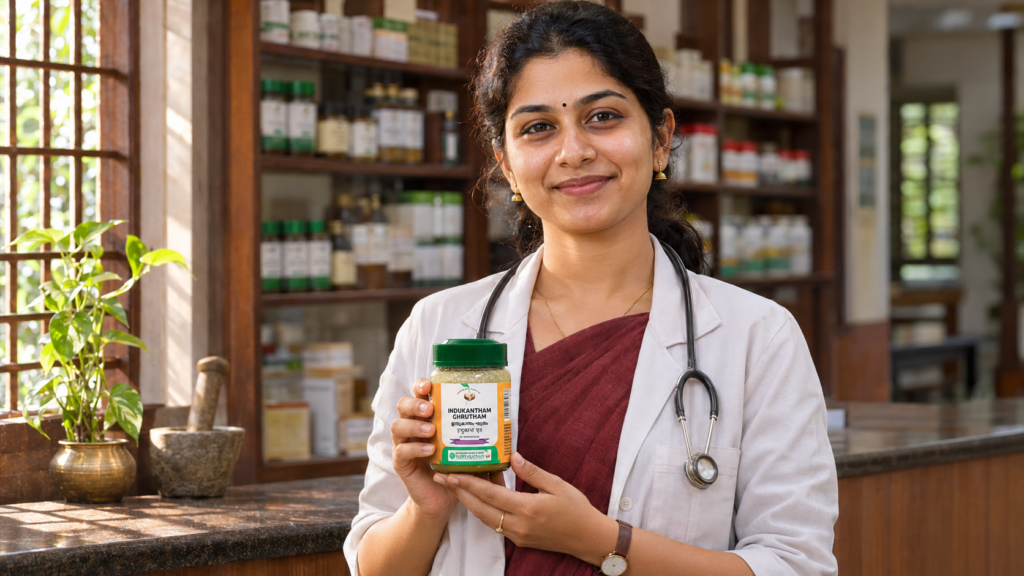
Indukantham Ghritham is a classical Ayurvedic medicated ghee (Ghrita) that helps the body recover strength, appetite and immunity after illness. It’s also traditionally used for chronic fever, Vata-type disorders like headache and neuralgia, postnatal weakness, and as an adjuvant in conditions like peptic ulcer and tuberculosis.
The name “Indukantham” reflects the moon’s gentle luminosity, the idea being that when illness dims a person’s inner vitality, this formulation helps restore it, much like a full moon lighting up a dark sky.
Indukantham Ghritham is prepared by cooking ghee with a decoction of its herbal ingredients until the active compounds are absorbed into the fat. Ghee has a particular quality in Ayurvedic pharmaceutics called Samskarasya Anuvartanat, meaning it takes on and carries forward the properties of the herbs cooked into it without losing its own essential nature. This is why medicated ghees like this one are considered especially effective carriers for herbal therapy, delivering the combined benefits of the Dashamoola roots, Devadaru and Puthikaranja in an easily assimilated form. It is taken internally and is particularly well known as a tonic for recovery after illness, chronic fever and postnatal weakness.
Ingredients
Indukantham Ghritham is prepared by a traditional process of decoction and ghee processing (Snehapaka). It is composed of the following ingredients:
- Holoptelea integrifolia (Puthikaranja) – eases general weakness and fatigue
- Cedrus deodara (Devadaru) – boosts overall energy and vitality
- Dashamoola (ten roots):
- Aegle marmelos (Bilva)
- Premna integrifolia (Agnimantha)
- Oroxylum indicum (Shyonaka)
- Gmelina arborea (Gambhari)
- Stereospermum suaveolens (Patala)
- Solanum indicum (Brihati)
- Solanum xanthocarpum (Kantakari)
- Desmodium gangeticum (Shalaparni)
- Uraria picta (Prishniparni)
- Tribulus terrestris (Gokshura)
- Ghrita (cow’s ghee) – the base medium
Ayurvedic properties of Indukantham Ghritham
Indukantham Ghritham is known for its Vata-balancing, digestion-supporting and strengthening action, built on the nourishing, carrying nature of ghee.
- Taste: Predominantly bitter and pungent, from the Dashamoola roots, balanced by the mild sweetness of ghee
- Qualities: Snigdha (unctuous) and Guru (heavy), characteristic of a ghee-based preparation
- Potency: A warming formulation overall, from the hot potency of Dashamoola and the mild pungency of Devadaru and Puthikaranja, while ghee itself has a calming, soothing effect on the digestive lining
- Action over doshas: Primarily balances Vata, with supportive action on Kapha
- Other actions: Deepana (kindles digestive fire), Balya (restores strength), Ojovardhaka (boosts immunity and vitality), Jwaraghna (relieves fever), Vedanasthapana (eases pain)
Use of Indukantham Ghritham in Ayurvedic Treatment
Indukantham Ghritham is used chiefly as a recovery and strengthening tonic following illness, and in the management of chronic Vata-related conditions. It is commonly used in:
- Chronic and intermittent fever
- General weakness and fatigue, especially after illness
- Weight loss and reduced appetite following recovery from sickness
- Vata Roga (Vata-type disorders), including headaches and neuralgia
- Postnatal weakness and recovery after childbirth
- Peptic ulcer, as a traditional adjuvant use
- Pulmonary tuberculosis, as a traditional adjuvant use
- Abdominal disorders, including bloating, gas and constipation
- As a Snehapana (internal oleation) preparation ahead of Panchakarma therapies for Vata disorders
How does Indukantham Ghritham work
Indukantham Ghritham works through the combined action of its Deepana (digestion-kindling), Balya (strength-restoring) and Vata-pacifying herbs. Dashamoola, the group of ten roots at the heart of the formula, is one of Ayurveda’s most established combinations for managing Vata-type disorders, and its warming nature helps kindle a weakened digestive fire (Agni) after illness, while also helping prevent the accumulation of Ama (metabolic toxins). Devadaru and Puthikaranja add further strength-restoring and pain-relieving support, and are traditionally credited with easing general weakness and fatigue.
The ghee base plays a central role here beyond simply being a carrier: it has a soothing effect on the gut lining even as the warming herbs stimulate digestion, which is part of why this formulation is considered gentle enough for recovery after illness, when the digestive system is often still fragile. Research on Indukantham Ghritham so far has looked at the formulation as a whole, mainly its effects on immune function: a pilot study in patients with recurrent upper respiratory tract infections found it improved markers of immune function, with liver and kidney function staying normal. Clinical research on the formulation remains limited, and its digestion-supporting (Deepana) action rests mainly on traditional use.
Conditions Indukantham Ghritham helps to treat
- Chronic and intermittent fever
- General weakness and fatigue
- Weight loss after illness
- Vata-type disorders, including headache and neuralgia
- Postnatal weakness
- Peptic ulcer (as an adjuvant)
- Pulmonary tuberculosis (as an adjuvant)
- Abdominal bloating, gas and constipation
- Poor appetite and digestive weakness
Benefits of Indukantham Ghritham
- Supports recovery of strength and energy after illness
- Helps regain healthy appetite and body weight following sickness
- Boosts immunity and overall vitality
- Supports healthy digestion and reduces bloating and gas
- Helps manage chronic and recurring fever
- Eases Vata-related pain, including headache and neuralgia
- Supports recovery and strength in new mothers during the postnatal period
- Suitable for both children and adults who fall ill frequently
Direction for usage
Indukantham Ghritham is taken orally:
- General dosage: Roughly 3-10 g (about ½ to 2 teaspoons) daily, adjusted according to the individual’s digestive strength (Jatharagni), age and constitution.
- Beginners are often started on a smaller dose, around 3 g in the morning, with the amount increased gradually under a physician’s supervision.
- In postnatal care, a higher dose of up to 10 g is sometimes used for a focused 7-14 day period, under medical guidance.
- It is often followed by a glass of warm, ginger-infused water, to support quick digestion of the ghee.
- Because this is a Ghrita (fat-based) preparation, the dose should always be matched to the individual’s digestive capacity, and determined by an Ayurvedic physician rather than self-selected.
Interaction with other medicine
There are no formal interaction studies on Indukantham Ghritham as a complete formulation. The precautions below are based on general principles for a ghee-based Dashamoola preparation. Anyone taking regular modern medicines should inform their doctor before starting Indukantham Ghritham, especially in the following cases:
- Cholesterol-lowering medicines: As a ghee-based (fat-rich) preparation, regular use should be accounted for by anyone managing dietary fat intake for cholesterol control.
- Medicines for peptic ulcer or acid reflux: Since this formulation is traditionally used as an adjuvant in peptic ulcer, anyone on prescribed ulcer medication should combine the two only under medical guidance, rather than substituting one for the other.
- Anti-tubercular medicines: Since Indukantham Ghritham has a traditional adjuvant role in tuberculosis recovery, it should only be used alongside, never in place of, standard anti-tubercular therapy, and only with the treating doctor’s knowledge.
- Fever and pain medicines (such as paracetamol, NSAIDs): Indukantham Ghritham is traditionally used for chronic fever, but should not replace proper medical evaluation of a persistent, high or unexplained fever.
- Medicines affecting uterine contraction, or use in pregnancy: Some sources note caution with certain Vata-stimulating herbs in large doses during pregnancy, since they may affect uterine activity. Pregnant women should use this only under close medical supervision.
- Sedatives and sleep medicines: If the specific formulation used includes calming herbs such as Ashwagandha or Shatavari, which some commercial versions add, there may be a mild additive calming effect.
Side effects
Indukantham Ghritham is generally safe and well tolerated when the dose is properly matched to the individual’s digestive strength. Taken in excess, or by someone with weak digestion, it may cause heaviness, mild indigestion or loose stools, given its ghee base. Discontinue use and consult a physician if persistent digestive discomfort or any allergic reaction develops.
Who should avoid it
- Individuals allergic to any of the ingredients
- People with high-grade fever, acute infections, or severe digestive disorders, who should have these properly addressed (including any necessary detoxification) before starting this formulation
- People managing high cholesterol or fat intake, unless the ghee-based dose is accounted for in their overall dietary plan
- Pregnant women, unless under strict medical guidance, since some included herbs may affect uterine activity in large doses
- People with very weak digestive fire (Agni), unless the dose is carefully adjusted by a physician
- Anyone with symptoms of active tuberculosis or peptic ulcer who has not yet started appropriate standard medical treatment, since this formulation is an adjuvant and not a substitute for that treatment
How to keep this medicine
- Store in a cool, dry place away from direct sunlight
- Keep the container tightly closed after use, to prevent rancidity
- Use a clean, dry spoon to avoid contamination
- Keep out of reach of children
- Do not exceed the recommended dosage
FAQ
Q. What is Indukantham Ghritham used for?
Indukantham Ghritham is mainly used to help the body recover strength, appetite and immunity after illness. It’s also traditionally used for chronic fever, Vata-type disorders like headache and neuralgia, postnatal weakness, and as an adjuvant in conditions like peptic ulcer and tuberculosis.
Q. How do you take Indukantham Ghritham?
Typical doses range from about 3 to 10 g (roughly ½ to 2 teaspoons) daily, depending on age, digestive strength and the condition being treated. It’s often followed by a glass of warm, ginger-infused water to aid digestion. The exact dose should be confirmed by an Ayurvedic physician.
Q. Does Indukantham Ghritham help with weight gain after illness?
Yes, this is one of its best-known traditional uses. It’s rich in Deepana (digestion-stimulating) and Ojovardhaka (immunity-boosting) herbs, which help restore appetite and support healthy weight regain following sickness.
Q. Is Indukantham Ghritham good for postnatal recovery?
Yes, it’s traditionally used to support strength and recovery in new mothers, with some practitioners using a higher dose for a focused period of around one to two weeks after delivery, under medical guidance.
Q. Does Indukantham Ghritham help with chronic fever?
Yes, it’s traditionally used for chronic and intermittent fever as part of its broader Vata-balancing, strength-restoring action, though persistent or high fever should always be properly evaluated by a doctor.
Q. Can children take Indukantham Ghritham?
Yes, it’s considered suitable for children who fall ill frequently, as a general immunity-boosting and digestive tonic, but the dose should be determined by a physician based on the child’s age and digestive strength.
Q. Is Indukantham Ghritham safe during pregnancy?
It should only be used in pregnancy under strict medical guidance, since some of its herbal ingredients may, in large doses, affect uterine activity.
Q. Who should avoid Indukantham Ghritham?
People with high-grade fever or acute infections (until these are addressed), those managing cholesterol or fat intake, pregnant women without medical guidance, and anyone with very weak digestion should avoid it or use it only under a physician’s supervision.
This article is for educational purposes only. Saatwika Ayurveda does not sell this medicine or recommend it for self-use. Ayurvedic medicines should be taken only when prescribed by a qualified Ayurvedic physician after a personal assessment.

Written by
Chief Physician, Saatwika Ayurveda
Dr. Salini L S is the Chief Physician of Saatwika Ayurveda, Thiruvananthapuram, with 18 years of experience in Ayurvedic practice. She completed her BAMS at MG University, Kerala, and trained under the late Chittattinkara Krishna Pillai Vaidyar. She specialises in Ayurvedic pain management, Panchakarma and women’s health, and is the Director of Saatwika Ayurveda Academy and Chairperson of Saatwika Ayurveda Research and Health Foundation.
View full profile →Saatwika Ayurveda, Trivandrum
Looking for Ayurvedic treatment for your condition?
Every treatment at Saatwika starts with a one-to-one assessment by our physician, who decides the therapies and medicines that suit you. Consult in person in Trivandrum or online.

