
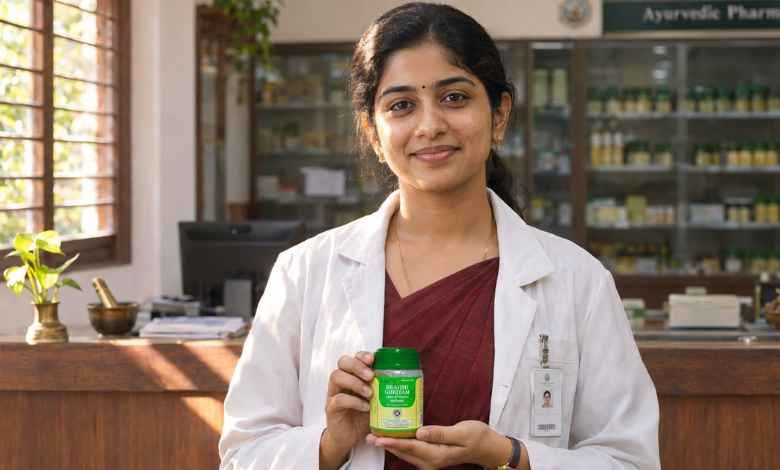
Brahmi Ghritham is a classical Ayurvedic medicated ghee (Ghrita), built around Brahmi (Bacopa monnieri) as its principal ingredient that can help support brain health with its nootropic and antioxidant action. It is indicated in traditional ayurvedic treatment as a supportive formula for dementia, seizure disorder, learning disability disorders- improves cognitive skills.
Brahmi Ghritham is prepared through the classical Snehapaka process, where fresh Brahmi juice is used as the liquid medium and cooked together with ghee and the other herbs over gentle, controlled heat across three days, until the mixture reaches the correct processing endpoint (Sneha Siddhi). This slow, repeated cooking is intended to transfer the lipophilic (fat-soluble) active compounds from the herbs into the ghee, so the final product carries their effects in a form the body can absorb more readily. It is taken internally and is one of Ayurveda’s most established formulations for supporting memory, mental clarity and emotional balance.
Ingredients
Brahmi Ghritham is prepared from the following ingredients, in the classical Charaka-style proportions:
- Bacopa monnieri (Brahmi) – 16 parts, the chief ingredient, used fresh as juice
- Ghrita (cow’s ghee) – 4 parts, the base medium
- Acorus calamus (Vacha) – 1 part
- Saussurea lappa (Kushtha) – 1 part
- Convolvulus pluricaulis (Shankhapushpi)
Ashtanga Hridaya and other later texts describe broader polyherbal variants of Brahmi Ghritham with additional supporting herbs, so commercial preparations can differ somewhat from this core classical formula; please check your specific product’s reference text if precision matters.
Ayurvedic properties of Brahmi Ghritham
Brahmi Ghritham is known for its Medhya (mind-supporting) and calming action, built on the cooling, nourishing qualities of ghee and Brahmi.
- Taste: Predominantly bitter (Tikta), with pungent notes from Vacha and Kushtha
- Qualities: Snigdha (unctuous) and Guru (heavy), characteristic of a ghee-based preparation
- Potency: Generally cooling (Sheeta), from Brahmi and ghee, tempered by the warming nature of Vacha and Kushtha
- Action over doshas: Primarily pacifies Vata and Pitta
- Key actions: Medhya (supports memory, intelligence and learning), Manasa Shamaka (calms the mind), Nidrajanana (supports healthy sleep in disturbed states)
Use of Brahmi Ghritham in Ayurvedic Treatment
Brahmi Ghritham is used chiefly in the management of mental and nervous system conditions. Classical indications consistently include:
- Unmada (psychiatric disorders)
- Apasmara (epilepsy and seizure disorders)
- Graha disorders (a classical category broadly covering unusual mental and behavioural states)
- Poor memory and concentration
- Depression and low mood (Vishada)
- General mental fatigue and stress
How does Brahmi Ghritham work
Brahmi Ghritham works mainly through Brahmi, which contains bacosides, compounds studied for cholinergic and synaptic-plasticity effects that are believed to underlie its traditional reputation as a memory and learning tonic. The ghee base is thought to assist this by carrying Brahmi’s fat-soluble active compounds more effectively into the central nervous system than a water-based preparation would. Vacha and Kushtha add further Medhya and calming support, while Shankhapushpi, a classical nervine herb in its own right, reinforces the formula’s traditional use for memory and mental calm.
Conditions Brahmi Ghritham helps to treat
- Poor memory and concentration
- Mild cognitive impairment, as emerging research suggests
- Depression and low mood (Vishada)
- Unmada (psychiatric disorders)
- Apasmara (epilepsy), as a traditional and adjuvant use
- Attention difficulties, including in children
- General mental fatigue and stress-related conditions
Benefits of Brahmi Ghritham
- Supports memory, learning and attention
- May help improve mood and ease depressive symptoms
- Calms the mind and supports mental clarity
- Traditionally used to support healthy sleep in disturbed states
- In a small trial in older adults, Brahmi herb (Bacopa monnieri) performed similarly to a standard memory medicine
- Generally well tolerated in the small clinical and toxicology studies conducted so far
Direction for usage
Brahmi Ghritham is taken orally:
- Adults: Doses used in clinical research have ranged from about 5-10 mL (or, in some studies, 6-10 g) twice daily, taken for periods of 30 to 90 days, depending on the condition studied.
- It is generally taken with warm milk or water, as advised by a physician.
- Because clinical study doses vary and this is a Ghrita (fat-based) preparation that should be matched to the individual’s digestive strength (Agni), the specific dose and duration should always be confirmed with an Ayurvedic physician rather than self-determined.
- With other Ayurvedic medicines: Brahmi Ghritham is sometimes used alongside other nervine or Rasayana formulations, such as Saraswatarishtam, or combined sequentially with digestive formulations like Trikatu Churna in some clinical protocols, but such combinations should be guided by a physician.
Interaction with other medicine
There are no dedicated interaction studies for Brahmi Ghritham. The precautions below are based on the known properties of its main ingredients, particularly Vacha, and on general principles for ghee-based preparations. Anyone taking regular modern medicines should inform their doctor before starting Brahmi Ghritham, especially in the following cases:
- Antidepressants, antipsychotics, and anti-epileptic medicines: Since Brahmi Ghritham is traditionally used for depression, psychiatric conditions and epilepsy, it should be combined with these medicines only under close medical supervision, and should never be used as a substitute for prescribed treatment in these conditions.
- Sedatives and sleep medicines: Given its calming, Medhya action, there may be an additive sedative effect when combined with these medicines.
- Cholinesterase inhibitors (such as donepezil), used in dementia care: A small trial comparing Brahmi herb (Bacopa monnieri) with donepezil found no significant difference in cognitive effects; anyone on such medicines should only combine the two under a doctor’s guidance.
- Cholesterol-lowering medicines: As a ghee-based (fat-rich) preparation, regular use should be noted by anyone managing their dietary fat intake for cholesterol control.
- Medicines metabolised by the liver, or people with liver disease: Because Vacha’s asarone compounds have raised some toxicological concerns in laboratory research, including potential hepatotoxicity at high or prolonged exposure, people with liver disease or on medicines that stress the liver should use this formulation cautiously and under medical supervision.
Side effects
Brahmi Ghritham has generally shown good tolerability. However, one of its typical ingredients, Vacha (Acorus calamus), contains asarone compounds that have raised safety questions in toxicological research, including concerns about long-term or high-dose exposure, this formulation should be used at physician-guided doses rather than indefinitely or in excess. Discontinue use and consult a physician if any unusual symptoms, digestive upset, or allergic reaction develop.
Who should avoid it
- Individuals allergic to any of the ingredients
- People with active liver disease, given the asarone-related safety questions associated with Vacha, unless specifically advised and monitored by a physician
- Pregnant or lactating women, unless specifically prescribed by a physician, since safety data in pregnancy is not established
- People with significant psychiatric or seizure conditions, who should use this only as an adjuvant alongside, and never as a replacement for, prescribed medical treatment
- People managing high cholesterol or fat intake, unless the ghee-based dose is accounted for in their overall dietary plan
How to keep this medicine
- Store in a cool, dry place away from direct sunlight
- Keep the container tightly closed after use, to prevent rancidity
- Use a clean, dry spoon to avoid contamination
- Keep out of reach of children
FAQ
Q. What is Brahmi Ghritham used for?
Brahmi Ghritham is mainly used to support memory, concentration and mental clarity, and is traditionally used for psychiatric conditions, epilepsy and depression. Modern research on it is still limited to small studies, mainly on attention and cognition.
Q. Does Brahmi Ghritham actually help with memory and cognition?
Early evidence is encouraging. A small clinical study in children with ADHD reported improved attention and behaviour scores with Brahmi Ghritham, and a trial of Brahmi herb in older adults with memory decline found results similar to a standard memory medicine. Larger trials are still needed.
Q. Does Brahmi Ghritham help with depression?
Small clinical studies published in Ayurvedic journals have explored Brahmi Ghritham for depressive symptoms, but it has not yet been tested in large placebo-controlled trials. It should be used alongside, not instead of, medically guided depression treatment.
Q. Can Brahmi Ghritham be taken with modern antidepressants or cognitive medicines?
It may be combined under a physician’s close supervision, but it should never replace prescribed psychiatric or anti-epileptic medication, and combinations should always be medically guided given the lack of formal interaction studies.
Q. Who should avoid Brahmi Ghritham?
People with active liver disease, pregnant or breastfeeding women without medical advice, and anyone with a known allergy to its ingredients should avoid it or use it only under a physician’s guidance.
This article is for educational purposes only. Saatwika Ayurveda does not sell this medicine or recommend it for self-use. Ayurvedic medicines should be taken only when prescribed by a qualified Ayurvedic physician after a personal assessment.

Written by
Chief Physician, Saatwika Ayurveda
Dr. Salini L S is the Chief Physician of Saatwika Ayurveda, Thiruvananthapuram, with 18 years of experience in Ayurvedic practice. She completed her BAMS at MG University, Kerala, and trained under the late Chittattinkara Krishna Pillai Vaidyar. She specialises in Ayurvedic pain management, Panchakarma and women’s health, and is the Director of Saatwika Ayurveda Academy and Chairperson of Saatwika Ayurveda Research and Health Foundation.
View full profile →Saatwika Ayurveda, Trivandrum
Looking for Ayurvedic treatment for your condition?
Every treatment at Saatwika starts with a one-to-one assessment by our physician, who decides the therapies and medicines that suit you. Consult in person in Trivandrum or online.

