
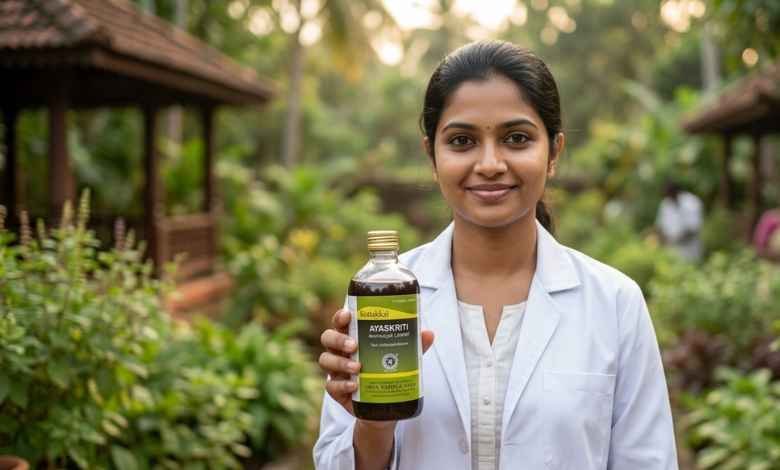
Ayaskriti is a classical Kerala Ayurvedic iron-based fermented liquid medicine (Asava) traditionally used to manage anaemia.
The name comes from Ayas (iron) and Kriti (preparation), because iron is processed along with herbal decoctions and honey.
Ayaskriti is prepared from a decoction of blood-purifying and astringent herbs such as Asana, Khadira, Chandana and Karanja, with Panchakola (five pungent digestive herbs).
Iron sheets are processed in this medium along with honey, and the mixture is fermented in a sealed vessel.
The Ayurvedic view is that the herbs improve digestion and absorption of iron, and the fermentation helps carry the medicine into the tissues.
It is taken internally and is best known as a blood-building tonic, with a supportive role in liver and spleen conditions, swelling, digestive weakness and certain skin conditions.
Ingredients
A traditional process of decoction, iron processing and fermentation prepares Ayaskriti.
It is a compound formulation with about 49 ingredients, and the exact list varies between manufacturers.
The main ingredients are:
Kwatha Dravya (decoction base):
- Pterocarpus marsupium (Asana, Venga)
- Acacia catechu (Khadira, Karingali)
- Santalum album (Chandana)
- Pongamia pinnata (Karanja, Ungu)
- Panchakola (five pungent herbs):
- Piper longum (Pippali, Thippali) – fruit
- Piper longum (Pippalimula) – root
- Piper chaba (Chavya)
- Plumbago zeylanica (Chitraka, Koduveli) – root
- Zingiber officinale (Shunthi, Chukku)
Loha Dravya (iron):
- Ayaspatra (processed iron sheets)
Madhura Dravya (sweetener):
- Madhu (honey)
Ayurvedic properties of Ayaskriti
Ayaskriti is known for its blood-building, digestive and Ama-digesting action, with a pungent and heating character.
- Action over Doshas: Kapha-Vata Shamaka (pacifies Kapha and Vata), Amapachana (digests Ama)
- Action over Tissues: Rakta-vardhaka (increases blood), relieves anaemia, Rasayana (supports restoration and recovery)
- Action over Metabolism: Deepana (improves digestive fire), Pachana (digests Ama), Vatanulomana (relieves gas and abdominal fullness)
- Action over Organs: Yakriduttejaka (stimulates the liver), helps with enlargement of the spleen
- Other Actions: Reduces swelling
- Prabhava (special potency): Loha Prabhava. Despite its bitter, pungent and astringent profile, Ayaskriti has a marked blood-increasing and anaemia-relieving effect because of the processed iron.
Because of its heating potency, it is best suited to Kapha-Vata dominant conditions, and it is used with care where Pitta is high.
Use of Ayaskriti in Ayurvedic Treatment
Ayaskriti is an important medicine in the management of anaemia in Keraleeya Chikitsa paddhati (the Kerala Ayurvedic treatment tradition).
It is commonly used in:
- Anaemia, especially with poor digestion and weakness
- Poor digestion and appetite
- Enlargement of the spleen and liver-related weakness
- Abdominal lumps and fullness
- Swelling, including swelling that accompanies anaemia
- Piles, as an adjuvant
- Skin diseases and vitiligo, as an adjuvant
- Diabetes, as an adjuvant
- Convalescence and post-illness weakness
It is often prescribed after Shodhana therapy (purification) in anaemia, and alongside a diet that supports blood formation.
How does Ayaskriti work?
Ayaskriti works through the combined action of iron and herbs that are Deepana (digestion-enhancing), Pachana (Ama-digesting) and Rakta-shodhaka (blood-purifying).
The processed iron is the main blood-building ingredient. It replenishes iron stores and supports the making of haemoglobin.
Panchakola, made up of pungent and warming herbs, sharpens digestion and absorption.
In the Ayurvedic view, the poorly digested and Ama-laden state that accompanies anaemia is corrected, so the iron can be used properly.
Asana, Khadira, Chandana and Karanja are bitter and astringent herbs that purify the blood, and they are also traditionally used in skin diseases and in diabetes.
Together with the bitter and pungent herbs, they support bile flow and the liver, which is closely linked to blood formation in Ayurveda. Fermentation with honey produces a small amount of self-generated alcohol.
In the Ayurvedic view this acts as a carrier (Yogavahi), taking the herbal principles quickly into the tissues.
Conditions Ayaskriti helps to treat
- Anaemia and iron-deficiency states
- Poor digestion and loss of appetite
- Enlargement of the spleen and liver-related weakness
- Abdominal lumps and fullness
- Swelling due to anaemia
- Piles (as an adjuvant)
- Skin diseases and vitiligo (as an adjuvant)
- Diabetes (as an adjuvant, under physician supervision)
- General weakness and post-illness debility
Benefits of Ayaskriti
- Helps replenish iron stores and supports haemoglobin formation
- Supports blood formation and relieves pallor and fatigue
- Improves digestive fire and appetite
- Helps digest Ama and reduces gas and abdominal fullness
- Supports the liver and spleen
- Helps reduce swelling that accompanies anaemia
- Supports energy and recovery from weakness
- Traditionally used as an adjuvant in certain skin conditions
Unlike gentle, cooling blood tonics, Ayaskriti is heating and stimulating in nature, so it is especially useful when anaemia comes with sluggish digestion, Ama and Kapha-Vata predominance.
Direction for usage
Ayaskriti is taken orally:
- Adults: 15–25 ml twice daily, mixed with an equal quantity of water, after food.
- Children (5 years and above): 5–10 ml twice daily, mixed with an equal quantity of water, after food.
- It is usually taken for a few weeks to a few months, depending on the condition. Haemoglobin and iron levels should be checked from time to time.
- Iron-containing medicines may darken the stools. This is usually harmless.
- The dose and duration should be decided by an Ayurvedic physician according to the condition, age and strength of the person.
With other Ayurvedic medicines: Ayaskriti is commonly combined with other Ayurvedic medicines, depending on the condition:
- In anaemia with weakness: with Draksharishtam, taken at a different time of the day
- In swelling with anaemia: with Punarnavasavam
- In piles and constipation: with Abhayarishtam
- In skin diseases: with Khadirarishtam
- In diabetes: with Nishakathakadi Kashayam
All such combinations should be taken on the advice of a physician. It should not be combined with other iron-based preparations, such as Lohasavam or Mandura Bhasma, unless prescribed, because the iron content adds up. When two Arishtas or Asavas are given together, the total amount of self-generated alcohol also increases.
Interaction with other medicines
Anyone taking regular modern medicines should inform their doctor before starting Ayaskriti, especially in the following cases:
- Iron tablets, iron syrups and injections: Taking them together adds up the iron dose and can lead to iron overload and stomach upset. Haemoglobin and ferritin should be monitored, and combined use should be under medical advice.
- Thyroid medicines (such as levothyroxine): Iron reduces the absorption of thyroid hormone. Keep a gap of at least 4 hours.
- Certain antibiotics (such as ciprofloxacin, levofloxacin, doxycycline, tetracycline): Iron binds to these medicines and reduces their absorption. Keep a gap of at least 2 to 3 hours, or as advised by the doctor.
- Bisphosphonates and some other medicines (such as alendronate, levodopa, methyldopa, penicillamine, mycophenolate): Iron can reduce their absorption, so they should be spaced apart as advised by the doctor.
- Antacids, proton pump inhibitors and calcium supplements: These can reduce the absorption of iron from Ayaskriti. Spacing the doses may help.
- Iron-chelating medicines (such as deferasirox, deferoxamine): These work against iron, so Ayaskriti should not be taken with them unless prescribed.
- Anti-diabetic medicines and insulin: Asana (Vijaysar) and Khadira have blood sugar-lowering activity, while honey adds sugar. Blood glucose should be monitored regularly, as the medicine dose may need adjusting.
- Medicines with a narrow dosing range (such as phenytoin, theophylline, propranolol): Piperine in long pepper may increase the absorption of some medicines, and this can raise their blood levels. Doses may need monitoring.
- Painkillers (NSAIDs) and steroids: These irritate the stomach lining, and iron and the pungent herbs can add to this. Caution is advised, especially in people prone to acidity or ulcers.
- Medicines that react with alcohol: Medicines such as metronidazole, tinidazole and disulfiram can react with even small amounts of alcohol, so Ayaskriti should be avoided during their use.
- Before surgery: Inform the surgeon and anaesthetist. Asana-containing medicines are usually stopped about two weeks before planned surgery because of their effect on blood sugar.
It is advisable to keep a gap of about 30 minutes between Ayaskriti and other medicines, and longer for the iron-sensitive medicines listed above.
Side effects
Ayaskriti is generally safe when taken in the recommended dose.
Iron-containing medicines may cause dark stools, mild constipation, nausea, a metallic taste or acidity, especially if taken on an empty stomach or in excess.
Rinsing the mouth after each dose helps avoid staining of the teeth.
Discontinue use and consult a physician if severe stomach pain, black tarry stools with weakness, vomiting or any allergic reaction develops.
Who should avoid it
- People with iron overload or haemochromatosis
- People with thalassaemia or those receiving repeated blood transfusions, unless prescribed by a physician
- People with active peptic ulcer, severe hyperacidity or gastritis
- People with acute bleeding disorders of Pitta origin, such as active heavy bleeding or bleeding piles with burning and heat, unless prescribed by a physician
- People taking other iron supplements or medicines that need spacing, unless advised by a physician
- Individuals allergic to any of the ingredients
- Diabetics, unless advised by a physician and with regular blood sugar monitoring, as the preparation contains honey and has a blood sugar-lowering action
- Pregnant or lactating women, unless prescribed by a physician
- People who need to avoid alcohol for medical, religious or personal reasons, as Asavas contain self-generated alcohol
How to keep this medicine
- Store in a cool, dry place away from direct sunlight
- Keep the bottle tightly closed after use
- Use a clean, dry measuring cup or spoon to avoid contamination
- Keep out of the reach of children. Accidental iron overdose is dangerous in children.
- Some sediment at the bottom is normal for Asavas.
FAQ
How to use Ayaskriti for anaemia?
Take 15–25 ml of Ayaskriti mixed with an equal quantity of water after food, twice daily, or as advised by your physician. It is used as a blood-building tonic in anaemia, especially when digestion is weak. Eating iron-rich and vitamin C-rich foods supports its action, while tea, coffee and milk taken close to the dose can reduce iron absorption. Anaemia needs proper evaluation to find the cause, such as blood loss or a nutritional deficiency, and haemoglobin should be rechecked during treatment.
When to take Ayaskriti?
Ayaskriti is generally taken after food, in the morning and evening, mixed with an equal quantity of water. Taking it after meals supports digestion and helps avoid stomach discomfort.
Can I use Ayaskriti for a long period?
Ayaskriti is usually taken for a few weeks to a few months, depending on the condition and the response. Because it contains iron, long-term use without monitoring can lead to iron accumulation, so it should always be under the supervision of an Ayurvedic physician, with blood tests at regular intervals.

