
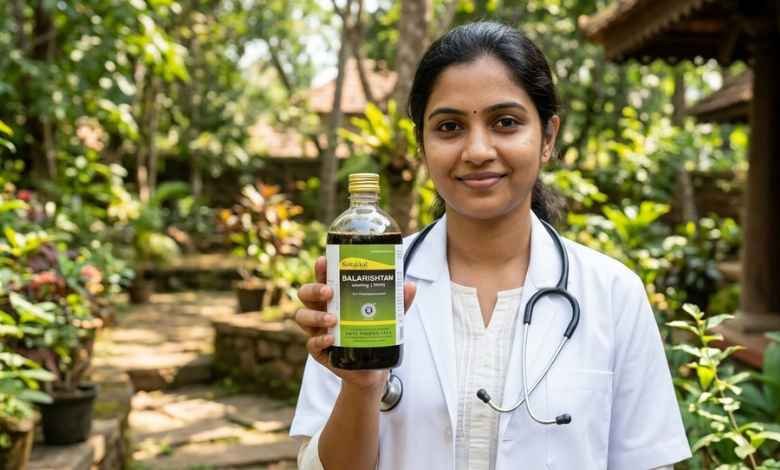
Balarishtam is a classical Ayurvedic fermented liquid medicine (Arishta) known for its Balya (strength-promoting) and Vatahara (Vata-pacifying) properties. It is one among the commonly prescribed formula for nerve, muscle and joint conditions of Vata origin.
Ingredients
Balarishtam is prepared by a traditional process of decoction, sweetening and fermentation. It is composed of the following ingredients:
Kwatha Dravya (decoction base):
- Sida cordifolia (Bala, Kurunthotti) – root
- Withania somnifera (Ashwagandha, Amukkuram) – root
Madhura Dravya (sweetener):
- Guda (jaggery)
Sandhana Dravya (fermentation initiator):
- Woodfordia fruticosa (Dhataki) – flowers
Prakshepa Dravya (aromatic and supporting herbs):
- Ricinus communis (Eranda, Avanakku) – root
- Leptadenia reticulata (Payasya / Kshirakakoli)
- Alpinia galanga or Pluchea lanceolata (Rasna), depending on the school of preparation
- Elettaria cardamomum (Ela, Elakka)
- Paederia foetida (Prasarini)
- Syzygium aromaticum (Lavanga, Grampoo) – flower bud
- Vetiveria zizanoides (Ushira, Ramacham) – root
- Tribulus terrestris (Gokshura, Njerinjil) – fruit
Ayurvedic properties of Balarishtam
Balarishtam is known for its Vata-pacifying action and its nourishing, strengthening and digestive effects.
- Action over Doshas: Vatahara (primarily pacifies Vata)
- Action over Tissues: Rasa-Rakta Dosha Hara (purifies Rasa and Rakta dhatus), Balya (promotes strength)
- Action over Metabolism: Pachana (digests Ama), Deepana (improves digestive fire)
- Other Actions: Balya (promotes strength), Brimhana (nourishes tissues), Shulaprasamana (soothes pain), Shophahara (reduces swelling), Deepana (improves digestive fire)
Its madhura rasa (sweet taste) and snigdha guna (unctuous quality) help manage Vata-related dryness, stiffness and pain, while the aromatic Prakshepa herbs keep the digestive fire (Agni) active so that the tonic can be assimilated well.
Use of Balarishtam in Ayurvedic Treatment
Balarishtam plays an important role in Vatavyadhi Chikitsa (management of Vata disorders) and Brimhana Chikitsa (nourishing therapy) in Keraleeya Chikitsa paddhati. It is commonly used in:
- Neuromuscular weakness and nerve debility
- Pakshaghata (hemiplegia) and Ardita (facial palsy), as an adjuvant
- Gridhrasi (sciatica) and Katishoola (low back pain)
- Sandhivata (osteoarthritis) and joint stiffness
- Muscle wasting, emaciation and general debility
- Chronic fatigue and digestive weakness
- Convalescence and post-illness recovery
In modern Ayurveda, it is often prescribed alongside Panchakarma and external therapies such as Abhyanga, Pizhichil, Njavarakizhi, Kati Basti and Janu Basti, and as a Shamana (pacifying) medicine after Snehana and Basti to sustain their benefits.
Published clinical reports also describe it as part of multi-therapy management of Pakshaghata (ischemic stroke) together with Panchakarma treatments.
How does Balarishtam work
Balarishtam works through the combined action of herbs that are Balya (strength-promoting), Vatahara (Vata-pacifying) and Deepana (digestion-enhancing).
Bala and Ashwagandha, the main ingredients, nourish the muscles and nerves and support strength and stamina.
Eranda and Rasna help manage Vata-related pain, stiffness and swelling. Gokshura supports the joints and general vitality.
Ela, Lavanga and Ushira improve digestion and absorption, so the tissues are nourished better.
The natural alcohol produced during fermentation acts as a carrier (Yogavahi) in the Ayurvedic view.
It helps extract the herbal principles and carry them quickly into the tissues.
Laboratory and animal studies support some of these traditional actions. Balarishtam has shown antioxidant (free-radical scavenging) activity, activity against common disease-causing microbes, and anti-inflammatory activity in a rat granuloma model.
Conditions Balarishtam helps to treat
- Vata disorders (Vatavyadhi)
- Nerve weakness and neuralgia
- Paralysis and facial palsy (as an adjuvant)
- Sciatica and low back pain
- Joint pain and osteoarthritis
- Muscle cramps and stiffness
- Cervical and lumbar spondylosis
- General weakness, emaciation and fatigue
- Loss of appetite and poor digestion
- Post-illness and post-surgical debility
Benefits of Balarishtam
- Supports muscle, bone and nerve strength
- Helps manage Vata-related pain and stiffness
- Improves digestive fire and appetite
- Nourishes the tissues (Dhatu) and supports recovery from weakness
- Helps reduce muscle cramps and spasms
- Supports joint and ligament strength
- Provides antioxidant support, as seen in laboratory studies
- Suitable for both adults and children in appropriate doses
- Can be combined with external oil therapies for better results
Unlike cooling, Pitta-pacifying preparations, Balarishtam has a warming, nourishing profile, which makes it especially suitable for Vata-dominant conditions.
Direction for usage
Balarishtam is taken orally:
- Adults: 15–30 ml twice daily, mixed with an equal quantity of water, after food.
- Children (5 years and above): 5–10 ml twice daily, mixed with an equal quantity of water, after food.
- The dose and duration should be decided by an Ayurvedic physician according to the condition, age and strength of the person.
- With other Ayurvedic medicines: Balarishtam is commonly combined with other Ayurvedic medicines, such as Maharasnadi Kashayam or Rasnairandadi Kashayam for Vata-related pain, Dhanwantharam Gulika for nerve and muscle weakness, and external oils such as Dhanwantharam Tailam or Kottamchukkadi Tailam for joint and muscle pain. All such combinations should be taken on the advice of a physician.
Interaction with other medicine
Anyone taking regular modern medicines should inform their doctor before starting Balarishtam, especially in the following cases:
- Thyroid medicines (such as levothyroxine): Ashwagandha may increase thyroid hormone levels. Thyroid function should be monitored.
- Anti-diabetic medicines and insulin: Ashwagandha may lower blood sugar, while the jaggery base adds sugar. Blood glucose should be monitored regularly.
- Blood pressure and heart medicines: Ashwagandha may lower blood pressure, whereas Bala contains ephedrine-type alkaloids that can raise blood pressure and heart rate. This may alter the effect of antihypertensives and heart medicines.
- Stimulants, decongestants and asthma medicines: These may add to the effect of the ephedrine content of Bala, and can cause palpitations, restlessness or tremor.
- Sedatives, sleep aids, anti-anxiety and anti-epileptic medicines: Ashwagandha and the alcohol content may add to drowsiness.
- Immunosuppressants: Ashwagandha may have an immune-stimulating effect, so it should be used with caution in people taking immunosuppressants, such as after organ transplant or in autoimmune conditions.
- Medicines that react with alcohol: Medicines such as metronidazole, tinidazole and disulfiram can react with even small amounts of alcohol, so Balarishtam should be avoided during their use.
- Before surgery: Inform the surgeon and anaesthetist. Ashwagandha-containing medicines are usually stopped about two weeks before planned surgery.
It is advisable to keep a gap of about 30 minutes between Balarishtam and other medicines.
Side effects
Balarishtam is generally safe when taken in the recommended dose. Rarely, mild acidity, stomach discomfort or loose stools may occur, especially if taken on an empty stomach or in excess. Because of the ephedrine-type alkaloids in Bala, sensitive individuals may occasionally feel palpitations, restlessness or sleeplessness. Discontinue use and consult a physician if any allergic reaction or persistent discomfort develops.
Who should avoid it
- Individuals allergic to any of the ingredients, such as Ashwagandha, clove or cardamom
- Diabetics, unless advised by a physician, as the preparation contains jaggery
- People with high blood pressure, heart rhythm disorders or an overactive thyroid, unless prescribed by a physician
- People with liver disorders, unless prescribed by a physician
- People who need to avoid alcohol for medical, religious or personal reasons, as Arishtas contain self-generated alcohol
- People with active Pitta-dominant conditions (such as hyperacidity or gastritis), unless prescribed by a physician
- Pregnant or lactating women, unless prescribed by a physician
How to keep this medicine
- Store in a cool, dry place away from direct sunlight
- Keep the bottle tightly closed after use
- Use a clean, dry measuring cup or spoon to avoid contamination
- Keep out of the reach of children
- Some sediment at the bottom is normal for Arishtas.
FAQ
How to use Balarishtam for knee pain?
Take 15–30 ml of Balarishtam mixed with an equal quantity of water after food, twice daily, or as advised by your physician. It is used as an internal adjuvant in Vata-type knee pain (Janu Sandhigata Vata). For best results, it is usually combined with external therapies such as Abhyanga with a Vata-pacifying oil and Janu Basti.
When to take Balarishtam?
Balarishtam is generally taken after food, in the morning and evening, mixed with an equal quantity of water. Taking it after meals supports digestion and helps avoid stomach discomfort.
Can I use Balarishtam externally?
No, Balarishtam is a fermented liquid meant only for internal use. For external application in muscle or joint pain, Bala-based oils such as Bala Taila or Balashwagandhadi Taila, or other Vata-pacifying medicated oils, are used instead, as advised by a physician.

