
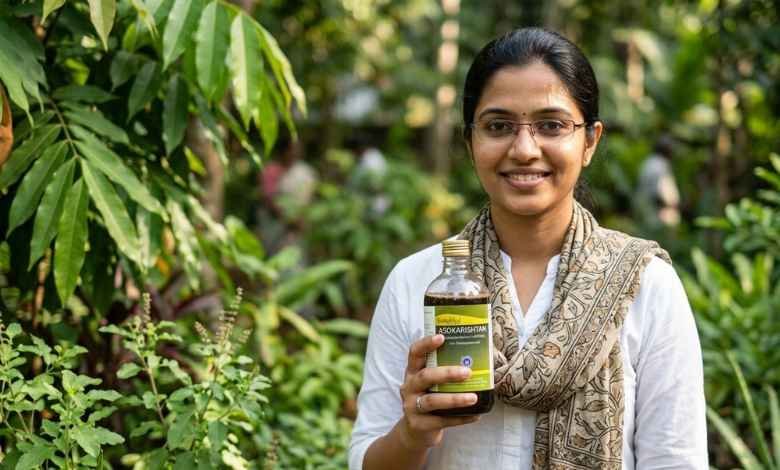
Ashokarishtam is a classical Ayurvedic fermented liquid tonic best known for supporting women’s reproductive health, especially heavy or irregular menstrual bleeding.
It develops a small amount of natural alcohol during fermentation, which Ayurveda holds helps the body absorb its herbal ingredients more effectively and gives the tonic mild astringent properties that help control excess bleeding.
Its main ingredient is the bark of the Ashoka tree (Saraca asoca), combined with herbs such as Dhataki flowers, cumin, dry ginger, sandalwood, and the Triphala trio of haritaki, bibhitaki and amalaki.
The bark is boiled into a decoction, the other herbs are added, the mixture is sweetened with jaggery, and it is left to ferment naturally.
This process is thought to draw out the astringent, cooling and anti-inflammatory compounds in these herbs and make them easier for the body to absorb, giving Ashokarishtam a supportive, toning action on the uterus and reproductive system.
Ingredients
A traditional process of decoction, sweetening, and fermentation prepares Ashokarishtam.
It typically has around 10-15 ingredients, and the exact list and proportions vary between manufacturers. The main ingredients are:
Decoction base:
- Saraca asoca (Ashoka) – bark
- Terminalia chebula (Haritaki)
- Terminalia bellirica (Bibhitaki)
- Emblica officinalis (Amalaki)
- Mangifera indica (Amrasthi, mango) – seed kernel
- Cyperus rotundus (Mustaka)
Sweetener:
- Guda (jaggery)
Fermentation aid:
- Woodfordia fruticosa (Dhataki) – flowers
Additives:
- Cuminum cyminum (Shweta Jeeraka, white cumin)
- Nigella sativa (Krishna Jeeraka, black cumin)
- Zingiber officinale (Shunthi, dry ginger)
- Santalum album (Chandana, sandalwood)
- Berberis aristata (Daruharidra)
- Nymphaea (Nilotpala, blue water lily)
- Adhatoda vasica (Vasa)
Ayurvedic properties of Ashokarishtam
Ashokarishtam is known for its bleeding-controlling, cooling, and pain-relieving action, with a light, sharp and heating character overall.
- Action over doshas: Balances Kapha and Pitta, supports the downward movement of Vata, strengthens the reproductive channel, digests metabolic toxins
- Action over tissues: Supports blood tissue and microcirculation, helps stabilise blood and reduce inflammatory heat
- Key actions: Controls excessive uterine bleeding, corrects gynaecological imbalances such as discharge and pelvic congestion, stimulates digestion, relieves cramping and spasm, reduces inflammation
Its astringent and cooling qualities help control heavy bleeding, while its warming, digestive herbs keep it from being too heavy on the stomach.
Use of Ashokarishtam in Ayurvedic Treatment
Ashokarishtam is a mainstay of women’s health support in Ayurvedic practice. It is commonly used in:
- Menorrhagia (heavy menstrual bleeding) and metrorrhagia (irregular uterine bleeding)
- Dysmenorrhoea (painful periods) and delayed or irregular periods
- Dysfunctional uterine bleeding
- Leucorrhoea (whitish or yellowish vaginal discharge)
- Menopausal symptoms and quality-of-life support during menopause
- Bleeding piles and nosebleeds, due to its astringent action
- Indigestion linked to excess Pitta
- General reproductive weakness and low energy in women
How does Ashokarishtam work
Ashokarishtam works through the combined action of its bleeding-controlling, cooling and digestive herbs.
Ashoka bark, the main ingredient, is rich in tannins and is traditionally regarded as one of the best uterine tonics in Ayurveda, helping tone the uterine tissue and reduce excessive bleeding.
Dhataki, Haritaki and Bibhitaki add to this astringent action. Cumin, dry ginger and Mustaka are carminative and anti-spasmodic, easing cramping and supporting digestion, while sandalwood and blue water lily have a cooling, soothing effect that balances the heating nature of the fermentation.
Fermentation with jaggery and Dhataki flowers produces a small amount of self-generated alcohol, which is believed to act as a carrier that helps the body absorb the herbal compounds more effectively.
Laboratory studies on the individual ingredients report antioxidant, anti-inflammatory and mild pain-relieving activity, and Ashoka bark itself has been studied for potential anti-tumour and antioxidant effects. Small clinical studies suggest Ashokarishtam, when combined with other Ayurvedic medicines, may help ease menopausal symptoms such as vaginal dryness and joint discomfort.
Conditions Ashokarishtam helps to treat
- Heavy or prolonged menstrual bleeding (menorrhagia)
- Irregular uterine bleeding (metrorrhagia)
- Painful periods (dysmenorrhoea)
- Delayed or irregular periods
- Leucorrhoea (vaginal discharge)
- Menopausal symptoms
- Bleeding piles
- Nosebleeds
- Indigestion related to excess Pitta
- General reproductive weakness
Benefits of Ashokarishtam
- Helps control heavy or irregular menstrual bleeding
- Supports uterine tone and overall reproductive health
- Eases menstrual cramps and discomfort
- Helps manage menopausal symptoms
- Provides relief in bleeding piles and reduces burning sensation
- Supports healthy digestion
- Has antioxidant and anti-inflammatory properties
- Helps improve overall strength and energy in women
Unlike heating tonics used for general debility, Ashokarishtam’s cooling, astringent action makes it especially suited to conditions involving excess bleeding or Pitta-related heat in the reproductive system.
Direction for usage
Ashokarishtam is taken orally:
- Adults: 15 to 30 ml twice daily, mixed with an equal quantity of water, after food, or as directed by a physician.
- It is usually taken for several weeks to a few months, depending on the condition, and often started a few days before the expected period for menstrual complaints.
- The dose and duration should be decided by an Ayurvedic physician according to the condition, age and strength of the person.
With other Ayurvedic medicines: Ashokarishtam is commonly combined with other Ayurvedic medicines, depending on the condition:
- In menopausal symptoms: with Ashwagandha Churna and Praval Pishti, which studies suggest may together give better relief from symptoms such as vaginal dryness and joint discomfort
- In painful periods and pelvic congestion: with Kumaryasavam or Dashamularishtam
- In bleeding piles: with Kankayan Gulika or Kankayan Vati
All such combinations should be taken on the advice of a physician. When two Arishtas or Asavas are given together, the total amount of self-generated alcohol also increases.
Interaction with other medicine
Anyone taking regular modern medicines should inform their doctor before starting Ashokarishtam, especially in the following cases:
- Hormonal medicines (such as hormone replacement therapy, oral contraceptives, medicines for heavy bleeding): Ashokarishtam is traditionally used for menstrual and menopausal complaints, so it should be combined with these medicines only under medical supervision, to avoid overlapping effects.
- Blood thinners and antiplatelet medicines (such as warfarin, clopidogrel, aspirin): The astringent, tannin-rich herbs may mildly affect clotting, so caution is advised, especially since Ashokarishtam is often used specifically for bleeding-related conditions.
- Anti-diabetic medicines and insulin: Daruharidra may lower blood sugar, while the jaggery base adds sugar. Blood glucose should be monitored regularly.
- Blood pressure and heart medicines: Excess or prolonged use of astringent, fermented tonics can occasionally affect fluid balance; people on blood pressure or heart medicines should use it under medical guidance.
- Immunosuppressants and steroids (such as azathioprine, methotrexate, tacrolimus, cyclosporine, prednisolone): Berberine from Daruharidra may affect the blood levels of some of these medicines, so caution is advised.
- Medicines that react with alcohol: Medicines such as metronidazole, tinidazole and disulfiram can react with even small amounts of alcohol, so Ashokarishtam should be avoided during their use.
- Before surgery: Inform the surgeon and anaesthetist, especially if heavy or unexplained bleeding is the reason for use, since it needs proper medical evaluation before any procedure.
It is advisable to keep a gap of about 30 minutes between Ashokarishtam and other medicines.
Side effects
Ashokarishtam is generally safe when taken in the recommended dose. Rarely, mild acidity, stomach discomfort or constipation may occur, especially if taken on an empty stomach or in excess, given its astringent and dry qualities. Discontinue use and consult a physician if any allergic reaction or persistent discomfort develops.
Who should avoid it
- Pregnant women, unless prescribed by a physician
- Individuals allergic to any of the ingredients
- People with severe gastritis or active acid-peptic irritation
- People with unexplained heavy bleeding that has not been medically evaluated
- Adolescents, unless the dose is guided by a clinician, since classical use is mainly for those who have started menstruating
- People who need to avoid alcohol for medical, religious or personal reasons, or those with alcohol sensitivity, as Arishtas contain self-generated alcohol
- People on blood thinners, unless advised by a physician
How to keep this medicine
- Store in a cool, dry place away from direct sunlight
- Keep the bottle tightly closed after use
- Use a clean, dry measuring cup or spoon to avoid contamination
- Keep out of the reach of children
- Some sediment at the bottom is normal for Arishtas.
FAQ
What is Ashokarishtam used for?
Ashokarishtam is mainly used for women’s reproductive health. It helps manage heavy or prolonged periods, irregular bleeding, painful periods, and vaginal discharge. It’s also used to ease menopausal symptoms, support uterine health, and help with bleeding piles and nosebleeds because of its astringent effect.How do you use Ashokarishtam for heavy periods?
Take 15 to 30 ml of Ashokarishtam mixed with an equal quantity of water, after food, twice daily, or as directed by your physician. It’s often started a few days before the expected period and continued through the cycle. Any heavy or unexplained bleeding should be evaluated by a doctor first, since several conditions can cause it.Can Ashokarishtam be taken daily?
Yes, it’s typically taken twice daily for several weeks to a few months, depending on the condition being treated. It’s meant for regular, sustained use rather than a one-time dose, but the duration should be guided by an Ayurvedic physician.How long does it take for Ashokarishtam to work?
Most people notice a difference over one to three menstrual cycles, since it works gradually to support uterine tone and regulate bleeding rather than acting immediately. For menopausal symptoms, benefits are usually seen after a few weeks to a couple of months of regular use.Does Ashokarishtam help with irregular periods?
Yes. It’s traditionally used for delayed, irregular and painful periods, along with metrorrhagia (irregular uterine bleeding) and dysfunctional uterine bleeding, as part of an overall Ayurvedic approach to menstrual health.Can Ashokarishtam help with menopause symptoms?
Yes. Ashokarishtam is used to ease menopausal symptoms and support quality of life during menopause. It’s often combined with other Ayurvedic medicines, such as Ashwagandha Churna and Praval Pishti, for better relief from symptoms like vaginal dryness and joint discomfort.Is Ashokarishtam safe to take for a long time?
It’s generally considered safe for extended use under medical guidance. However, because it’s fermented and contains a small amount of natural alcohol, and has astringent, drying qualities, long-term use should be monitored by an Ayurvedic physician, especially in people with digestive sensitivity.Does Ashokarishtam contain alcohol?
Yes, like other Arishta preparations, Ashokarishtam contains a small amount of self-generated alcohol produced during natural fermentation. This helps with absorption of the herbal ingredients, but people who need to avoid alcohol for medical, religious or personal reasons should be cautious.Can Ashokarishtam be taken with other medicines?
It can be combined with certain Ayurvedic medicines under a physician’s guidance, but people on hormonal medicines, blood thinners, anti-diabetic drugs or immunosuppressants should consult their doctor first, since some ingredients may interact with these.Who should avoid Ashokarishtam?
Pregnant women, people with severe gastritis, unexplained heavy bleeding that hasn’t been medically evaluated, and those who need to avoid alcohol should avoid it unless a physician advises otherwise. Adolescents should use it only under clinical guidance.Can Ashokarishtam be used for bleeding piles?
Yes, its astringent and cooling properties are traditionally used to help reduce bleeding and burning sensation associated with piles, alongside other prescribed treatments.

