
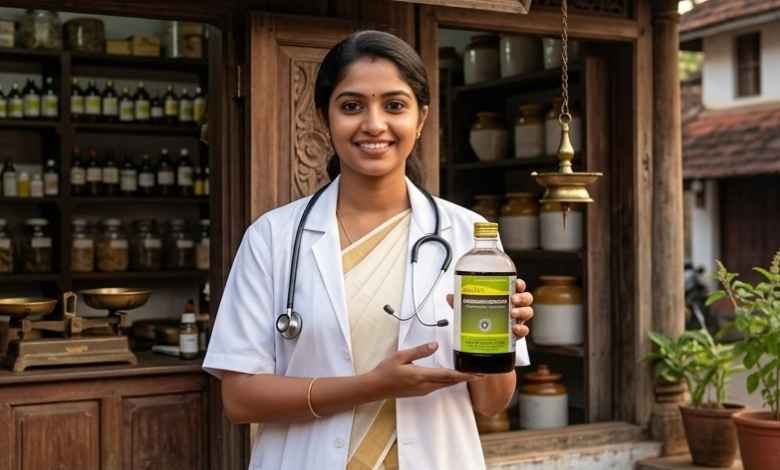
Aragwadharishtam is a classical Ayurvedic fermented liquid tonic traditionally used for skin health, worm infestation, and mild constipation.
It is made by fermenting a herbal decoction, which gives it a small amount of natural alcohol that helps the herbs act quickly once taken.
The main ingredient is Cassia fistula (golden shower tree) pulp, combined with neem, giloy (guduchi), and moringa, along with other blood-purifying herbs.
This mixture is sweetened with jaggery, fermented naturally, and finished with a blend of aromatic herbs.
According to Ayurveda, the fermentation process helps draw out and better absorb the active compounds in the herbs, supports healthy digestion, and helps purify the blood and clear toxins linked to skin problems.
Ingredients
A traditional process of decoction, sweetening and fermentation prepares Aragwadharishtam.
The classical formula includes about 21 ingredients, and the exact list varies slightly by manufacturer.
The main ingredients are:
Kwatha Dravya (decoction base):
- Cassia fistula (Aragvadha, Kanikonna) – fruit pulp
- Azadirachta indica (Nimba, Veppu)
- Tinospora cordifolia (Guduchi, Chittamruthu)
- Moringa oleifera (Shigru, Muringa)
- Cyclea peltata (Patha)
- Ficus racemosa (Udumbara, Athi)
- Trichosanthes anguina or dioica (Patola, Padavalam)
Madhura Dravya (sweetener):
- Guda (jaggery)
Sandhana Dravya (fermentation aid):
- Woodfordia fruticosa (Dhataki, Thathiripoo) – flowers
Prakshepa Dravya (additives):
- Emblica officinalis (Amalaki, Nellikka)
- Terminalia chebula (Haritaki, Kadukka)
- Embelia ribes (Vidanga)
- Operculina turpethum (Trivrit)
- Elettaria cardamomum (Ela, Elakka)
- Syzygium aromaticum (Lavanga, Grampoo) – flower bud
- Piper nigrum (Maricha, Kurumulaku)
- Madhu (honey)
Ayurvedic properties of Aragwadharishtam
Aragwadharishtam is known for its blood-purifying, skin-clearing and mildly purgative action, with a light, sharp and heating character.
- Action over Doshas: Kapha-Pitta Shamaka (pacifies Kapha and Pitta), Amapachana (digests Ama), Mala-shodhana (cleanses waste products), Rakta-prasadana (purifies blood)
- Action over Metabolism: Deepana-Pachana (improves digestive fire and digests Ama)
- Action over Tissues: Rakta-prasadana (purifies blood), supports liver-linked detoxification
- Other Actions: Kushthaghna (clears skin disease), Krimighna (antimicrobial and anthelmintic), Shophahara (reduces swelling), Virechaka (mild laxative-purgative, chiefly through the anthraquinone-rich Aragvadha fraction)
- Prabhava (special potency): Despite its overall sweet-fermented character, Aragwadharishtam shows a marked Kushthaghna-Raktashodhaka (skin-clearing, blood-purifying) effect driven by Aragvadha and the Arishta processing.
Use of Aragwadharishtam in Ayurvedic Treatment
Aragwadharishtam plays an important role in Kushtha Chikitsa (management of skin disease) and Rakta-shodhana (blood-purifying) therapy in Keraleeya Chikitsa paddhati. It is commonly used in:
- Chronic and stubborn skin diseases
- Itching and Eczema-like conditions
- Vitiligo, as an adjuvant
- Urticaria and other pruritic skin conditions
- Worm infestation
- Chronic and non-healing wounds
- Anaemia, as an adjuvant, when linked with skin conditions
- Sprue-like malabsorption states and mild oedema
- Constipation associated with Kapha-Pitta accumulation
In Ayurvedic practice it is often combined with external therapies for skin disease, such as Lepa (herbal paste application), medicated baths and Virechana-based Panchakarma protocols.
How does Aragwadharishtam work?
Aragwadharishtam works through the combined action of herbs that are Kushthaghna (skin-clearing), Krimighna (antimicrobial), and mildly Virechaka (purgative).
Aragvadha, the main ingredient, contains anthraquinone-type compounds that gently promote bowel evacuation and help eliminate Kapha and Pitta from the digestive tract, which Ayurveda links closely to skin health.
Neem and Guduchi purify the blood and support the body’s resistance to skin infections, while Moringa, Patha, Udumbara and Patola help reduce inflammation and clear Ama.
The bitter, astringent and pungent herbs together support Rakta-prasadana (blood purification) and help correct the underlying digestive sluggishness that Ayurveda sees behind many skin conditions.
Fermentation with jaggery and Dhataki flowers produces a small amount of self-generated alcohol, which in the Ayurvedic view acts as a carrier (Yogavahi), improving extraction and bioavailability of the herbal principles while further reducing Ama.
Conditions Aragwadharishtam helps to treat
- Chronic and stubborn skin diseases (Kushtha)
- Itching, eczema and pruritic skin conditions
- Vitiligo (as an adjuvant)
- Urticaria and allergic skin reactions
- Worm infestation
- Chronic and non-healing wounds
- Anaemia associated with skin conditions (as an adjuvant)
- Sprue-like malabsorption
- Mild oedema
- Constipation with Kapha-Pitta predominance
Benefits of Aragwadharishtam
- Supports the body’s natural process of clearing skin disease
- Helps relieve itching and skin irritation
- Purifies the blood and supports liver-linked detoxification
- Helps manage worm infestation
- Supports wound healing
- Provides mild, natural laxative action and supports regular bowel movement
- Helps digest Ama and reduce Kapha-Pitta accumulation
- Can be combined with external therapies for better results in skin disease
Unlike purely nourishing tonics, Aragwadharishtam is Sara (mobile) and mildly purgative in nature, so it is especially useful when skin disease is accompanied by Ama and sluggish elimination.
Direction for usage
Aragwadharishtam is taken orally:
- Adults: 15–25 ml twice daily, mixed with an equal quantity of water, after food.
- Children (5 years and above): 5–10 ml twice daily, mixed with an equal quantity of water, after food.
- It is usually taken for several weeks to a few months, depending on the skin condition, under a physician’s guidance.
- The dose and duration should be decided by an Ayurvedic physician according to the condition, age and strength of the person.
With other Ayurvedic medicines: Aragwadharishtam is commonly combined with other Ayurvedic medicines, depending on the condition:
- In skin diseases: with Khadirarishtam or Mahamanjishthadi Kashayam
- In fever with skin disease: with Amritarishta
- In worm infestation: with Vidangarishtam or Krimighna Choornam
- In constipation: with a mild Ayurvedic laxative such as Triphala Churna, on the advice of a physician
All such combinations should be taken on the advice of a physician. When two Arishtas or Asavas are given together, the total amount of self-generated alcohol also increases, and their combined laxative effect should also be kept in mind.
Interaction with other medicines
Anyone taking regular modern medicines should inform their doctor before starting Aragwadharishtam, especially in the following cases:
- Laxatives and stool softeners: Aragvadha and Trivrit both have a purgative action, so taking them together may cause excessive purgation, cramping or dehydration.
- Anti-diabetic medicines and insulin: Aragvadha, Neem and Guduchi may lower blood sugar, while the jaggery and honey add sugar. Blood glucose should be monitored regularly, as the medicine dose may need adjusting.
- Blood thinners and antiplatelet medicines (such as warfarin, clopidogrel, aspirin): Some of the herbs may mildly affect platelet function and clotting, so caution is advised.
- Diuretics and blood pressure medicines: Excessive purgation can lead to fluid and electrolyte loss, which may add to the effect of these medicines. Electrolytes may need monitoring with prolonged use.
- Immunosuppressants and steroids (such as azathioprine, methotrexate, tacrolimus, cyclosporine, prednisolone): Guduchi has an immune-stimulating effect and may work against these medicines. This matters especially in autoimmune skin conditions and organ transplant recipients.
- Medicines that react with alcohol: Medicines such as metronidazole, tinidazole and disulfiram can react with even small amounts of alcohol, so Aragwadharishtam should be avoided during their use.
- Sedatives, sleep aids and anti-epileptic medicines: The alcohol content may add to drowsiness.
- Before surgery: Inform the surgeon and anaesthetist. Guduchi-containing medicines are usually stopped about two weeks before planned surgery.
It is advisable to keep a gap of about 30 minutes between Aragwadharishtam and other medicines.
Side effects
Aragwadharishtam is generally safe when taken in the recommended dose. Because of its mild purgative action, loose stools, abdominal cramping or increased bowel frequency may occur, especially with higher doses or prolonged use. Mild acidity or stomach discomfort may also occur if taken on an empty stomach or in excess. Discontinue use and consult a physician if diarrhoea, dehydration or any allergic reaction develops.
Who should avoid it
- Pregnant women
- People with active diarrhoea, severe dehydration or an acute flare of irritable bowel syndrome
- Very weak, elderly or debilitated patients, unless prescribed by a physician
- People with a markedly dry (Vata-dominant) constitution, unless prescribed by a physician
- People already taking laxatives, anticoagulants or anti-diabetic medicines, unless the combination is supervised by a physician
- Children, unless under medical supervision
- People who need to avoid alcohol for medical, religious or personal reasons, as Arishtas contain self-generated alcohol
How to keep this medicine
- Store in a cool, dry place away from direct sunlight
- Keep the bottle tightly closed after use
- Use a clean, dry measuring cup or spoon to avoid contamination
- Keep out of the reach of children
- Some sediment at the bottom is normal for Arishtas.
FAQ
How to use Aragwadharishtam for skin diseases?
Take 15–25 ml of Aragwadharishtam mixed with an equal quantity of water after food, twice daily, or as advised by your physician. Some brands recommend a different schedule, such as a higher dose on an empty stomach a couple of times a fortnight, so it’s best to follow your product label or physician’s advice. It works well for itching, eczema-like conditions and stubborn skin disease when combined with external therapies. Persistent, extensive or worsening skin disease needs proper medical evaluation.
When to take Aragwadharishtam?
Aragwadharishtam is generally taken after food, in the morning and evening, mixed with an equal quantity of water, though some formulations are taken on an empty stomach as directed by the physician or the product label.
Can I use Aragwadharishtam for a long period?
Aragwadharishtam is usually taken for several weeks to a few months for skin conditions, depending on the response. Because of its purgative action, long-term use should be under the supervision of an Ayurvedic physician, with attention to bowel habits and hydration.

